
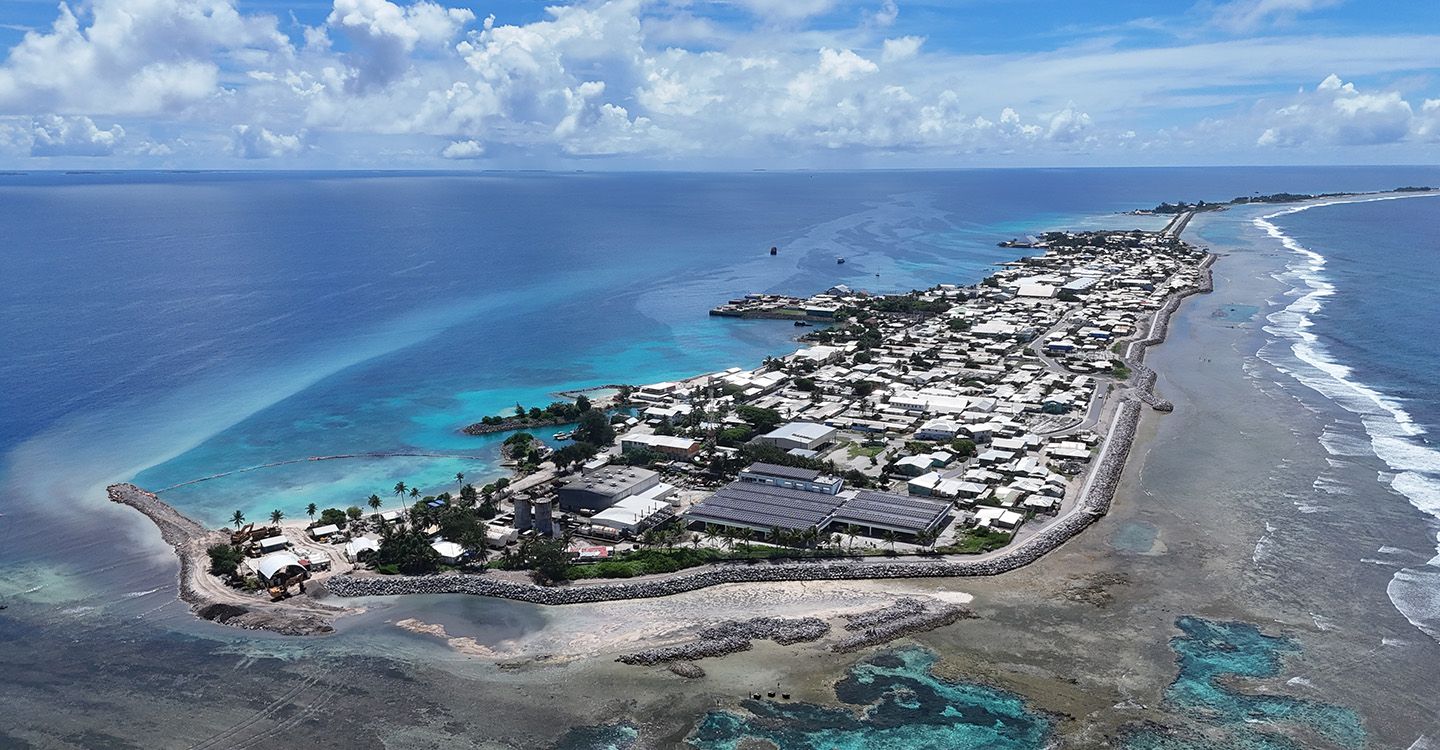
Hall Contracting has successfully delivered a major coastal protection project in the Republic of the Marshall Islands (RMI), constructing a new 1.81km seawall to protect one of the Pacific’s most climate-vulnerable communities from coastal flooding, wave overtopping and rising sea levels.
The project marks a significant milestone for the low-lying island of Ebeye in the Kwajalein Atoll, strengthening protection for residents, homes, roads and critical infrastructure while delivering environmental improvements for the local community.
Constructed by Australian dredging and marine infrastructure company Hall Contracting and designed by international consulting engineering firm Haskoning on behalf of the RMI Ministry of Public Works, Infrastructure and Utilities (MPWIU), the seawall will provide long-term protection from sea level rise of up to 0.5 metres.
Dr Martin Budd, Technical Director at Haskoning, said completing the seawall marked an important moment for Ebeye and the wider Marshall Islands.
“It demonstrates how well-designed climate adaptation infrastructure can provide tangible protection for communities already experiencing the impacts of a changing climate, while delivering lasting benefits that improve everyday life,” Mr Budd said.
For the first time, residents can safely walk along the island’s ocean frontage using an illuminated footpath incorporated alongside the new coastal defences. The route provides a connection from one end of the island to the other, improving access to the waterfront during the day and evening when sea conditions allow.
The seawall has also been integrated with the island’s new road drainage scheme, helping roads drain more effectively during periods of heavy rainfall.
Hall Contracting CEO & Director Cameron Hall said the project had required the mobilisation of extensive equipment and materials to the remote island, including 84,000 tonnes of armour rock and fill.
“Mobilising the large volumes of equipment and materials required to such a remote location was a major logistical undertaking,” Mr Hall said.
“Our team sourced the specialised armour rock from the United Arab Emirates and coordinated its transport to the Marshall Islands via bulk carrier, while also mobilising significant plant, equipment and construction materials from Australia via barge.”
Mr Hall said the project had created valuable employment and training opportunities, including opportunities for Marshallese women to gain experience in traditionally male-dominated construction roles.
“At peak workforce levels, we employed approximately 35 Marshallese workers on the project alongside our expatriate team, with these team members receiving training in operating plant and survey equipment,” he said.
“This project highlights what can be achieved in remote Pacific communities by combining strong technical capability with careful logistical planning and meaningful local participation.”
Construction also transformed Ebeye’s ocean frontage, with 1,500 tonnes of waste cleared during the works. Steel was removed for recycling, while discarded concrete was repurposed, leaving the coastline significantly cleaner.
The Rukjellen Ebeye Seawall and Footpath was implemented by the Government of the Republic of the Marshall Islands under the Pacific Resilience Program – Phase II (PREP II), This project forms part of the Government’s ongoing efforts to strengthen climate and disaster resilience. The initiative was funded by the World Bank, Green Climate Fund and the Government of the Republic of the Marshall Islands (GRMI) and has received significant local support from the community, the Kwajalein Atoll Development Authority (KADA), Kwajalein Atoll Local Government (KALGov) and Kwajalein Leaders.
Hall Contracting and Haskoning Australia recognise and thank all those who contributed to the successful delivery of this important climate resilience project.


